Quick Answer: Forensic accounting in a New Jersey divorce follows six stages, engagement, document collection, financial analysis, interviews, report preparation, and expert testimony if needed, and typically takes anywhere from a few weeks for a simple review to 6-12+ months for complex, contested cases.
In New Jersey, divorce means dividing everything that got built up during the marriage. That sounds straightforward until you realize one spouse handled all the finances, or owns a business, or has income that seems to shift depending on what's convenient.
When the money picture isn't clear, you can't divide things fairly. That's where a forensic accountant divorce specialist comes in.
I've worked on a lot of these cases in New Jersey. The spouse who didn't manage the money often walks in feeling like they're at a disadvantage.
They don't know what accounts exist. They don't understand how the business is valued. They're not sure if the income being reported is the whole story. My job is to figure that out.
What a Forensic Accountant
Actually Does in a Divorce
Forensic accounting for divorce cases means going through financial records to see what's really there.
That includes looking at bank statements, tax returns, credit card records, business financials, loan applications, retirement accounts, and anything else that shows where money came from and where it went.
We're looking for the full picture. Sometimes that picture matches what's being disclosed. Sometimes it doesn't.
In New Jersey divorces, the court uses equitable distribution. That doesn't necessarily mean 50/50. It means fair, based on a bunch of factors.
But "fair" only works if everyone's working from accurate numbers. If assets are hidden or income is understated, the division can't be equitable. It's built on bad information.
The Forensic Accounting Process, Step by Step
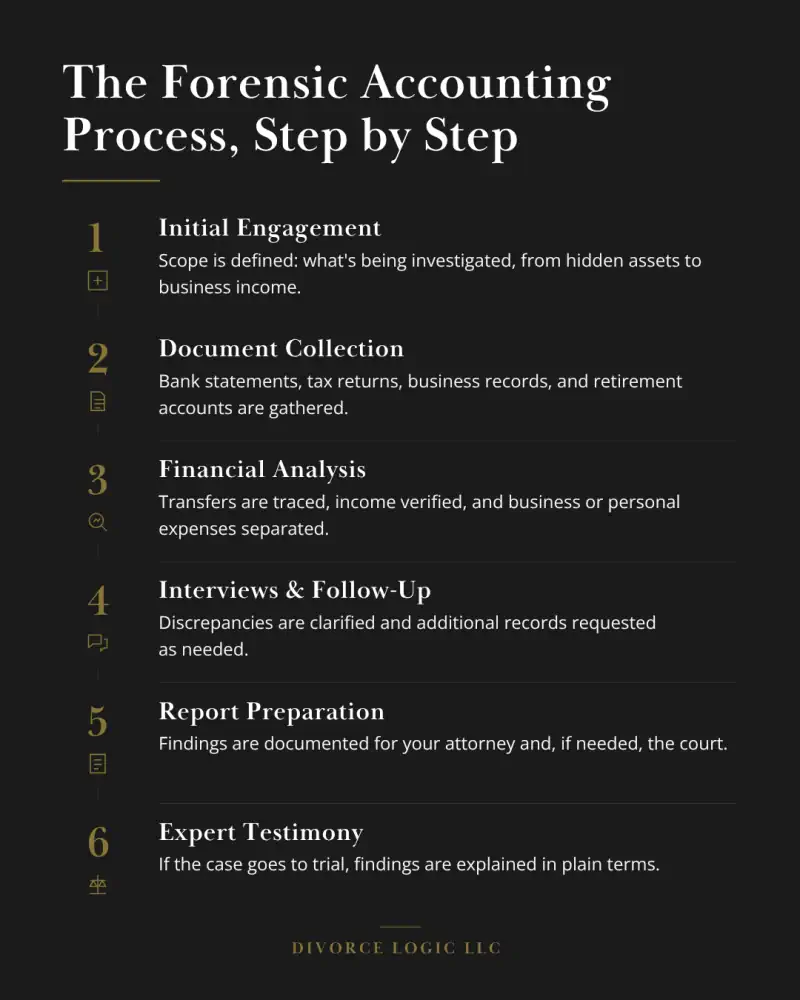
- Initial engagement - scope is defined: what's being investigated (hidden assets, business income, undisclosed accounts)
- Document collection - bank and credit card statements, tax returns, business records, retirement and investment accounts, obtained largely through New Jersey's discovery process
- Financial analysis - tracing transfers, separating business from personal expenses, verifying income against lifestyle, valuing a business if one is part of the estate
- Interviews and follow-up - clarifying discrepancies, requesting additional records when numbers don't reconcile
- Report preparation - findings documented for your attorney and, if needed, the court
- Expert testimony - if the case goes to trial, testifying to explain the findings in plain terms
How Financial Inconsistencies Get Uncovered

There's no single trick to uncovering hidden assets in a divorce. It's usually a combination of things that don't line up.
Lifestyle versus reported income. Someone says they earn $120,000 a year, but they're driving a new BMW, taking vacations to Europe, and paying private school tuition for two kids. That math doesn't work. Either income is higher than reported, or money is coming from somewhere that wasn't disclosed.
This is where a lifestyle analysis comes in. Support calculations typically start with reported income, W-2s, 1099s, K-1s, but when cash income is involved, those numbers alone don't always capture the full picture. I look at actual spending, housing costs, travel, everyday expenses, to help establish what income figure is appropriate for a support calculation. In states with income caps on support, this same analysis can help show that a family's actual spending exceeds what the capped, reported income would suggest.Business irregularities. Business owners have more ways to move money around. Cash payments that don't hit the books. Personal expenses written off as business costs. Salaries paid to family members who don't actually work there. Revenue that dips right before divorce papers get filed and mysteriously recovers afterward. The IRS requires all cash income to be reported, regardless of whether a formal payment record exists, which is exactly why these patterns stand out during forensic review.
Unexplained transfers. Money that moves to accounts in someone else's name. "Loans" to friends or relatives. Large cash withdrawals without receipts. Overpaying the IRS one year to get a big refund the next, after the divorce is finalized.
Newer, less obvious asset types. Balances sitting in payment apps like Venmo, Cash App, or Apple Pay. Cryptocurrency held across exchanges or personal wallets. Unused gift cards. Money moved through platforms like GoFundMe that look like charitable giving but function as a transfer to someone else.
I look at all of it. Bank records going back several years. Tax returns compared against what was actually deposited. Business profit-and-loss statements compared against the lifestyle. When things don't match, that's where we dig deeper.
New Jersey Specifics That Matter
New Jersey is an equitable distribution state, which means the court has discretion in how assets get divided, which may be viewed as fair but not necessarily equal, as outlined by the New Jersey Courts.
Judges look at factors like the length of the marriage, each spouse's income and earning potential, contributions to marital property, and the standard of living during the marriage.
That last part matters a lot. If one spouse claims they can't afford much in support because business is slow, but the family has been living like business is great, the court needs to see that. Forensic analysis shows it.
New Jersey courts also have strong discovery rules. Both sides are supposed to disclose everything. But disclosure only works if someone's checking. A forensic accountant reviews what's been provided and identifies what's missing or doesn't add up.
Another thing I see often in New Jersey: business valuations that are inconsistent.
A spouse who owns a business might get it valued at one number for the divorce while using a completely different number for a loan application or insurance policy. Financial forensics in divorce cases catches exactly this kind of discrepancy.
How Long Does Forensic Accounting Take in a New Jersey Divorce?
- Simple financial review: 2-6 weeks
- Moderate divorce or business case: 1-3 months
- Complex cases (multiple entities, suspected hidden assets): 3-6 months or longer
- Large, highly contested litigation: 6-12+ months, especially when new records surface during discovery
- How promptly both spouses produce financial records
- The number of accounts, business entities, and investments involved
- Whether a business valuation is required alongside the review
- Court discovery deadlines and requests for supplemental analysis
Real Scenarios (Names Changed)
The contractor with cash income. A woman came to us because her husband, who ran a contracting business, claimed his income had dropped significantly the year they separated. She knew it didn't make sense because work had actually picked up. We reviewed bank deposits, job invoices, and compared against reported income. He'd been taking more payments in cash and not reporting them. That changed the support calculation significantly.
The executive with deferred compensation. A husband had stock options, restricted stock units, and deferred bonuses through his company. His wife knew he made good money, but didn't understand how much was tied up in these future payouts. We traced the compensation packages, valued what was marital versus separate, and built a clear picture. Without that, she would have walked away from assets she was entitled to.
The hidden account. A spouse found a credit card statement for an account she didn't know existed. That led us to a bank account that had never been disclosed. The account wasn't huge, but it raised questions about what else wasn't on the table. The answer turned out to be a brokerage account with six figures in it.
Seeing any of these situations in your own divorce? Schedule a consultation and let's take a look at what the numbers actually show.
How This Supports Your Legal Team
Attorneys handle the legal strategy. We handle the financial analysis. When those two work together, the case is stronger.
We put together reports that attorneys can use in negotiations or present in court. We explain where the numbers came from, what doesn't match, and what it means for asset division. If things go to trial, we can testify as expert witnesses and stand behind our findings.
In mediation, having solid financials keeps the conversation grounded. It's harder to argue about money when there's a clear, documented picture of what exists.
When to Bring in a Forensic Accountant

Not every divorce needs forensic work. But if your spouse controlled the finances, owns a business, has income that fluctuates, or if you just feel like you're not seeing everything, it's worth a conversation.
The earlier you bring someone in, the better. We can guide the discovery process and make sure the right questions get asked up front. Waiting until after a settlement is signed makes everything harder.
If you're going through a high-asset divorce in New Jersey and the financial side feels unclear, Divorce Logic can help you get a real picture of what you're dealing with. That's the starting point for everything else.
Frequently Asked Questions
How long does forensic accounting take in a NJ divorce?
Most straightforward reviews take one to three months. Cases involving a business, suspected hidden assets, or contested litigation can take six months to a year or more. The pace depends less on the complexity of the finances and more on how quickly both spouses produce the records requested during discovery.
Who pays for a forensic accountant in a divorce?
This varies by case. Sometimes one spouse pays out of pocket, sometimes the cost is shared between both parties, and in some New Jersey cases a judge orders one spouse to advance the fee, particularly when there's a significant income disparity. Your attorney can advise on how this applies to your situation.
Can a forensic accountant testify in court?
When should I bring in a forensic accountant?
As early as possible, ideally before or at the start of discovery, so the right documents get requested from the outset. Waiting until after financial disclosures are already exchanged, or worse, after a settlement is signed, makes it much harder to identify gaps or request additional records later on.
Book a consultation and let's talk through your situation.
Book a Confidential Consultation

Jay Mota, MAFF/CVA, CDFA®, CFP®, CQS, ChFC, WMCP
Divorce Financial Forensic Expert & Founder, Divorce Logic
Jay is a nationally recognized divorce financial professional with more than 25+ years of experience in the financial industry. As a divorce financial forensic expert, Jay reviews and analyzes the financial circumstances of individuals who are considering, navigating, or finalizing a divorce. He provides insight, analysis, projections, and strategic guidance to clients and attorneys to support informed decision-making and potential settlement.
Jay serves clients in all 50 states, helping them navigate complex financial situations during divorce with confidence and clarity.