
Is alimony taxable? Federally, spousal support paid under agreements signed after 2018 isn't taxable to the recipient or deductible by the payer. Older agreements and some states differ.
TL;DR
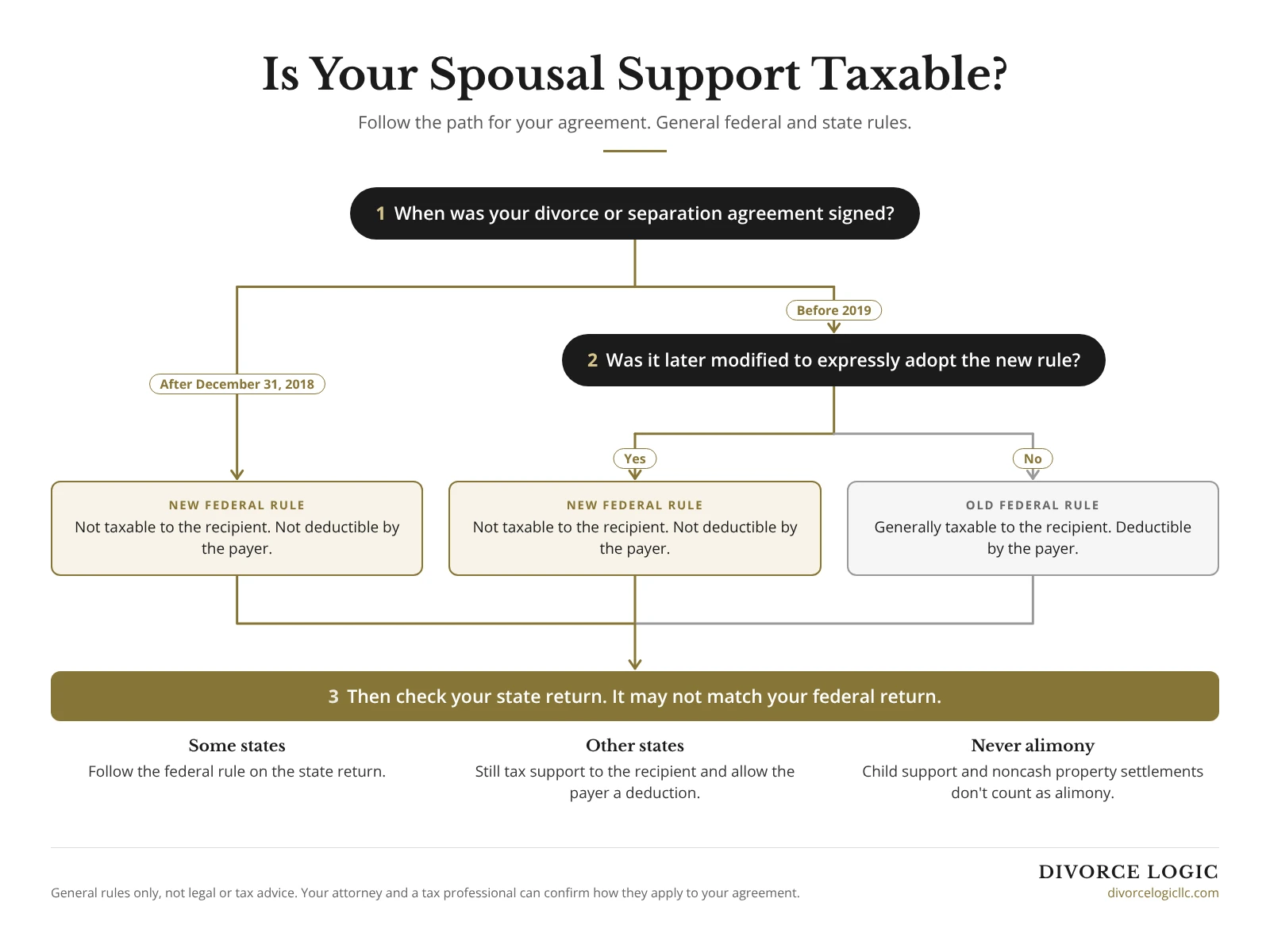
- For agreements signed after December 31, 2018, federal law treats spousal support as not taxable to the recipient and not deductible by the payer.
- Agreements signed before 2019 generally keep the old treatment (taxable to the recipient, deductible by the payer) unless a later modification expressly adopts the new rule.
- New Jersey and New York still generally tax spousal support to the recipient and allow the payer a deduction on the state return. Massachusetts has followed the federal treatment since tax year 2022.
- The after-tax number, not the headline number, is what you'll actually live on. Compare settlement options on that basis before you sign.
Divorce is hard. Negotiating support while you're also figuring out where you'll live and how the bills will get paid can feel like a lot at once. So it makes sense that "is alimony taxable" is one of the first questions people ask when a support number lands on the table.
The answer changes what that number is worth. This article covers how support payments are taxed and what that means for your settlement. For how dividing assets is taxed, see our guide to divorce and taxes.
A quick note on terms: "spousal support" is the everyday name for these payments. The IRS calls them alimony or separate maintenance, so you'll see both terms below.
This article is general education, not legal or tax advice. Your attorney and a tax professional can tell you how these rules apply to your agreement.
Is Alimony Taxable for Agreements Signed After 2018?
No, not on your federal return. Under federal law, the payer can't deduct spousal support paid under an agreement executed after 2018, and the recipient doesn't include those payments in gross income.
The date that matters is when the divorce or separation agreement was executed, not when the divorce was filed. That's why two people divorced in the same year can face different tax treatment.
What Counts as Alimony for Tax Purposes?
Not every payment in a divorce counts. Under IRS rules, a payment generally must be made in cash (including checks or money orders) under a divorce or separation instrument, and the agreement can't designate it as something other than alimony.
Two common payments don't count as alimony for tax purposes:
- Child support. It's never deductible and isn't considered income.
- Noncash property settlements. A property settlement isn't alimony, whether it's paid in a lump sum or in installments.
How your agreement labels and structures a payment matters. That's a drafting question for your attorney, with input from a tax professional.
How Does Tax Treatment Change What Spousal Support Is Worth?
It changes how much of each payment you actually keep, and how much each payment actually costs the spouse who pays it. Two offers with the same face value can be worth very different amounts once taxes are applied.
As Jay Mota, CDFA® and founder of Divorce Logic, puts it: "Numbers on paper don't equal reality in divorce. Divorce is nuanced."
A Simple Comparison: Support Payments vs. Property of Equal Face Value
Here's a simplified illustration. The numbers are invented, and the tax rate is an assumption chosen only to show the math. It isn't a real bracket, and your actual rates will differ.
Assumptions for this illustration only: Option A is $30,000 a year of spousal support for four years ($120,000 total). Option B is a $120,000 brokerage account transferred now, with $40,000 of built-in (embedded) gain. Any taxable amount is taxed at an assumed 25%.
| Face value | If no tax applies | If the assumed 25% applies | |
|---|---|---|---|
| Option A: support payments | $120,000 | $120,000 kept | $90,000 kept |
| Option B: brokerage account | $120,000 | $120,000 if held | $110,000 if sold (tax on the $40,000 gain) |
What the table shows:
- Option A depends on the agreement date and your state. Under a post-2018 agreement, the federal return doesn't tax the support. If your state still taxes it, as New Jersey and New York generally do, part of each payment goes to state tax.
- Option B isn't taxed when it changes hands, but the gain comes with it. Property transferred between spouses because of a divorce generally isn't taxed at transfer. The receiving spouse may owe tax on the built-in gain when the property is later sold. Our guide to divorce and taxes covers that side in more detail.
- The payer's side moves too. Where a deduction applies (a pre-2019 agreement, or a state that still allows one), each dollar of support costs the payer less than a dollar after tax. Where it doesn't, the payer funds support from after-tax income.
Real rates on ordinary income and on investment gains are often different, which is exactly why this comparison needs your real numbers.
Taxes aren't the only difference. Support arrives over time, and its terms are set by your agreement and state law, while property is in your name once it transfers. Weighing those trade-offs, and deciding whether any trade belongs in your settlement, is a conversation for you and your attorney.
Why the After-Tax View Matters Before You Sign
In Jay's words: "Cash flow is probably the foundation to the settlement." The question isn't only how much support is offered. It's how much will reach your account each month after taxes, and whether that covers the life you're planning.
That's the kind of analysis a divorce financial planner brings to the table. Our planning work includes tax impact planning for settlement options and coordination with your attorney, accountant, and mediator. Planning covers the tax impact of settlement options, not filing returns, so your tax professional stays part of the team.
With the after-tax numbers in front of you, the options get easier to compare.
Is Alimony Tax Deductible If Your Agreement Was Signed Before 2019?
Generally, yes. For agreements executed before 2019, spousal support payments are generally deductible by the payer and included in the recipient's income, as long as they meet the IRS requirements for alimony.
If you receive taxable support, plan ahead for the tax on it. A tax professional can help you decide whether estimated payments or extra withholding make sense.
What Happens If You Modify a Pre-2019 Agreement?
Modifying an older agreement doesn't automatically change its tax treatment. A pre-2019 agreement moves to the new federal rule only if the modification expressly states that the repeal of the alimony deduction applies.
Whether to modify an agreement, and how the modification is worded, are questions for your attorney. A tax professional can then confirm how the new wording is likely to be treated on both the federal and state returns.
Is Alimony Taxable at the State Level?
It depends on your state. Some states follow the federal rule, while others still tax spousal support to the recipient and let the payer deduct it on the state return. That means a single payment can be tax-free on your federal return and taxable on your state return.
Wherever you live, a few questions can help you get a clear picture:
- Does your state follow the federal treatment? Some states adopted the post-2018 federal rule, and others kept the older treatment for state purposes.
- Which tax year are you looking at? A state can change its approach over time, so the rule for an older return may differ from the rule today.
- Do you and your former spouse file in different states? The payer and the recipient may not be on matching rules.
- Who can confirm it for your situation? A tax professional, or your state’s tax department, can tell you how your state treats your payments.
We work with clients in all 50 states, and our offices are in New Jersey, New York and Massachusetts. Those three states show how far apart the rules can be, so we’ll use them as examples.
| State | Payer | Recipient |
|---|---|---|
| New Jersey (alimony) | Can deduct court-ordered payments | Generally taxable |
| New York (spousal maintenance) | Subtracts applicable payments for NY purposes | Adds applicable payments for NY purposes |
| Massachusetts (alimony) | Can't deduct for post-2018 agreements (tax years 2022 and later) | Not included for post-2018 agreements (tax years 2022 and later) |
This means a single support payment can be tax-free on your federal return and taxable on your state return. Both returns belong in the math.
New Jersey
New Jersey's own rules still treat alimony as income to the recipient. The state's divorce tax guide says alimony is taxable to the recipient under N.J.S.A. 54A:5-1(n), and that because alimony isn't subject to withholding, the recipient may need to pay more New Jersey tax through estimated payments or added withholding.
On the payer's side, New Jersey allows a deduction for court-ordered alimony or separate maintenance payments. Voluntary payments made outside a divorce or separation decree aren't deductible. New Jersey's guidance doesn't tie this treatment to the date the agreement was signed.
There is one exception in the state's guidance: alimony could be considered nontaxable if the divorce decree stipulates that the paying spouse agrees not to claim the deduction, and the Division of Taxation may review the decree before deciding. Whether that applies to you is a question for your attorney and a tax professional.
If you're working through support in New Jersey, our New Jersey team works alongside your attorney on the financial side.
New York
New York chose not to follow the federal change for spousal maintenance (the IRS refers to these payments as alimony). Under the state's guidance, for agreements executed after December 31, 2018, the payer subtracts applicable payments from federal adjusted gross income, and the recipient adds them back, when figuring New York income.
This treatment is still in place. The 2025 New York instructions list an addition modification for maintenance payments received and a subtraction modification for payments made. A pre-2019 agreement that's modified later falls under these adjustments only if the modification expressly says so.
So in New York, maintenance under a newer agreement is generally tax-free on the federal return but taxable on the state return. If you're negotiating spousal maintenance in New York, that state tax belongs in the after-tax comparison.
Massachusetts
Massachusetts now follows the federal treatment. For tax years 2022 and later, alimony is not deductible by the payer when paid under a divorce or separation instrument executed after December 31, 2018, and the recipient doesn't include it in Massachusetts gross income. The same applies to certain earlier agreements that were later modified to expressly adopt the new treatment.
Before 2022, Massachusetts followed an older version of the federal tax code, so alimony remained deductible and taxable on Massachusetts returns even after the federal change. If you're reviewing older Massachusetts returns, or you have an agreement signed before 2019, a tax professional can confirm how your payments are treated for the years in question.
If you're negotiating alimony in Massachusetts, the state and federal treatment now line up for newer agreements, which simplifies the comparison.
Before You Sign
Whether spousal support is taxable depends on two things: when your agreement was signed and which state taxes you. Once you know both, you can compare support, property, and other options on what they're actually worth to you.
A few practical steps can help:
- Confirm the date your agreement was, or will be, executed.
- Ask your attorney how any proposed payment is labeled and structured.
- Have a tax professional review the federal and state treatment for both spouses.
- Compare your options on after-tax cash flow, not face value.
You don't have to sort this out alone. With your attorney, a tax professional, and a financial expert working from the same numbers, you can make the decision with a clear view of what you're agreeing to.
Frequently Asked Questions
Is child support taxable?
No. For federal tax purposes, child support is never deductible by the payer and isn't considered income to the recipient. If an agreement requires both spousal support and child support and the payer pays less than the total, the payments apply to child support first.
Is a property settlement treated as alimony?
No. For federal tax purposes, noncash property settlements, whether paid in a lump sum or in installments, aren't alimony. Property transferred between spouses because of a divorce generally isn't taxed at the time of transfer, but the receiving spouse may owe tax when the property is later sold.
What if my former spouse and I live in different states?
The state tax treatment of spousal support can differ depending on where each of you files, so the payer and the recipient may not be on matching rules. Because these situations vary, have a tax professional review both sides before you rely on an after-tax number.
Does Divorce Logic prepare tax returns?
No. Divorce Logic analyzes the tax impact of settlement options but does not prepare tax returns, and investment management is not one of its services. For filing questions, work with a CPA or other tax professional.
Can you help after my divorce is final?
Yes. Divorce Logic offers post-divorce financial planning. If you already have a support agreement in place, planning can help you see how its after-tax value fits your budget and goals moving forward.
Bridging the Gap Between Finance & Law.
Schedule a Confidential Consultation

Jay Mota, MAFF, CVA, CDFA, CFP, CQS
Founder and Principal of Divorce Logic
Jay is a nationally recognized divorce financial professional and has worked in financial services since 1997. As a divorce financial forensic expert, Jay reviews and analyzes the financial circumstances of individuals who are considering, navigating, or finalizing a divorce. He provides insight, analysis, projections, and strategic guidance to clients and attorneys to support informed decision-making and potential settlement.
Jay serves clients in all 50 states, helping them navigate complex financial situations during divorce with confidence and clarity.