
Divorce asks you to make permanent financial decisions while you're exhausted and stretched thin, and the retirement account is often where those decisions carry the most weight. Federal guidance notes that retirement savings are one of the most significant assets many Americans own. Vanguard reports the average 401(k) balance among its plan participants reached $167,970 at year-end 2025.TL;DR
- A settlement agreement sets the terms, but the 401(k) plan divides the account only after it receives and approves a QDRO.
- Done correctly, your share can move by direct rollover without current tax. Cash paid to you from the plan under a QDRO is an IRS exception to the 10% early withdrawal penalty.
- The most important work happens before you sign. The agreement needs language the plan can follow, including how any loan is handled.
- Divorce Logic reviews settlement language and handles the QDRO from drafting through final submission to the plan administrator, alongside your attorney.
If you're working out how to divide a 401k in divorce, there's good news: the process is well defined. It has specific steps, a specific document, and a few predictable places where things go wrong. This guide walks through each one so you know what to ask for, and when.
Why Does Dividing a 401(k) Take More Than a Settlement Agreement?
A 401(k) plan follows a qualified domestic relations order, not your settlement agreement. The agreement records what you and your spouse decided. The QDRO is a separate court order that tells the plan how to carry it out.
The reason is federal law. State law generally governs how property is divided in a divorce. Any assignment of retirement benefits must also meet federal requirements under ERISA (the federal law that governs most private employer retirement plans) and the Internal Revenue Code, and that means a QDRO. In practice, most plans require a former spouse to file a QDRO with the plan administrator before any portion can be paid.
As Jay Mota, CDFA® and founder of Divorce Logic, puts it: "A settlement agreement awards you a percentage of a retirement plan. But when it comes to retirement division, the plan administrator reads the QDRO, not the agreement."
For a broader primer on the order itself, start with our QDRO basics guide.
How to Divide a 401(k) in Divorce, Step by Step
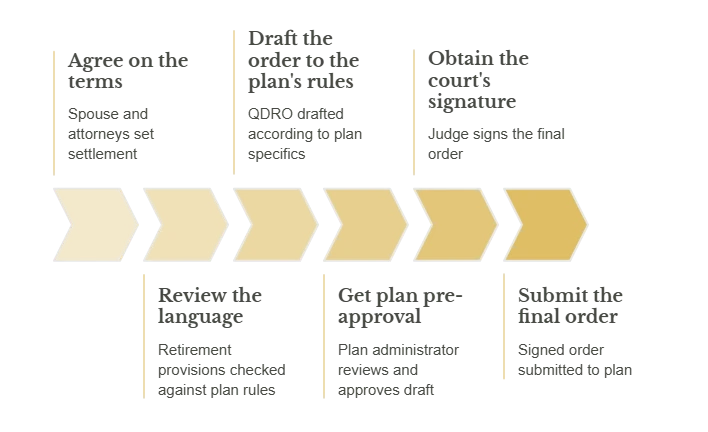
Every plan has its own procedures, but the path generally looks like this:
Agree on the terms. You and your spouse, with your attorneys or mediator, set out in the settlement agreement how the 401(k) will be divided.
Review the language. The retirement provisions are checked against what the plan actually allows, before anyone signs.
Draft the order to the plan's rules. Each plan gets its own order. A QDRO can't award a benefit or form of payment the plan doesn't offer, so the draft has to follow that plan's rules.
Get plan pre-approval. The draft goes to the plan administrator, who decides whether it qualifies.
Obtain the court's signature. A judge signs the order.
Submit the final order. The signed order goes back to the plan, which then separates the former spouse's share.
This mirrors the process Jay describes. There is a separate order for each plan, drafted to that plan's rules, approved by the plan, signed by the judge, and returned to the plan to carry out. Timing depends on the plan and on how quickly administrators respond. The process typically takes 1 to 6 months from start to finish.
Jay's advice for this stage is simple: "You really have to understand the plan. You have to understand what's available in the plan."
Accounts That Don't Use a QDRO
IRAs don't require a QDRO. They are divided with IRA transfer paperwork.
TSP accounts and military pensions don't use a QDRO either. They need a Retirement Benefits Court Order or a DFAS-compliant order. TSP is the Thrift Savings Plan for federal employees and service members, and DFAS is the Defense Finance and Accounting Service.
What Should Your Settlement Agreement Say Before You Sign?
Your settlement agreement should include language specific enough that a QDRO can be drafted from it and accepted by the plan. Vague wording can stall retirement division for months.
Jay explains: "The settlement agreement has to have specific language in it in order to dictate how the QDROs are going to be drafted." He describes what happens when that language is missing: the plan won't accept the order as drafted, and clients are sent back to their attorneys to amend the agreement.
QDRO language. The agreement should call for an order for each plan being divided.
Any 401(k) loan. This applies whether or not a loan exists (more on this below).
The order of operations. If a separate amount is meant to come off the balance before the split, the wording needs to say so in that sequence. Subtracting before or after the split changes how much is divided.
Every plan benefit. Knowing what the plan offers helps confirm that the agreement doesn't leave anything out.
Your attorney drafts the agreement and advises on its terms. A financial specialist checks that the numbers and the plan mechanics work the way everyone intends. The Department of Labor's federal guidance makes the same point: gather plan information early, and don't leave the QDRO for the end.
What Happens to a 401(k) Loan in Divorce?
An outstanding 401(k) loan needs to be addressed in the settlement agreement, and the QDRO has to reflect it. If the agreement is silent, the plan may not accept the order.
Jay is direct about it: "When drafting the QDROs, loans need to be addressed, whether there are loans or there are not loans."
Plan loans also come with their own rules. Under IRS loan rules, repayment generally must happen within 5 years, and a plan may require the spouse of a married participant to consent to a loan. The loan balance, the repayment schedule, and how the loan is treated in the division are all part of the financial picture to understand before you agree to a number.
This is one of the easier issues to fix on paper before signing. It is much harder to fix after an order has been rejected.
Do You Have to Pay Taxes on a 401(k) Divorce Settlement?
Generally, no tax is due when a 401(k) is divided under a QDRO and your share moves by direct rollover. Income tax generally applies when money is actually withdrawn.
The IRS explains that a former spouse who receives QDRO benefits reports the payments as if they were the plan participant. That spouse can roll a QDRO distribution over tax-free, the same way an employee could.
How the money moves makes a real difference. Under the IRS rollover rules:
If your share is... | What generally happens |
|---|---|
Moved by direct rollover to your IRA or another eligible plan | No mandatory withholding, and tax is deferred |
Paid to you as a check | The plan generally withholds 20% for federal income tax, even if you plan to roll it over |
Paid to you, then rolled over within 60 days | To defer tax on the full amount, you have to replace the 20% withheld using other funds |
This is general information about how IRS rules work, not tax advice for your situation, so a tax professional should help you apply it to your return. Divorce Logic analyzes the tax impact of settlement options but does not prepare tax returns. For a wider look at how divorce affects your taxes, see our guide to divorce and taxes.
Can You Avoid the 401(k) Early Withdrawal Penalty in Divorce?
Often, yes. When a 401(k) pays a former spouse directly under a QDRO, that distribution is one of the IRS listed exceptions to the 10% additional tax on early withdrawals.
Normally, money taken from a 401(k) before age 59½ is subject to a 10% additional tax on top of regular income tax. The QDRO exception can matter a great deal if you need cash during or after the divorce. Three details are worth knowing:
Income tax still applies. The exception removes the 10% additional tax, not regular income tax.
It doesn't carry over to IRAs. The IRS lists the QDRO exception for qualified plans like a 401(k), not for IRAs. If you roll your share into an IRA and later withdraw before age 59½, the 10% can apply unless another exception fits.
It requires a QDRO. A withdrawal a spouse takes on their own, outside a QDRO, follows the usual early withdrawal rules.
Because of that second point, it helps to think through how much cash you may need before deciding where the rest of your share goes. A financial specialist and a tax professional can help you weigh that timing together.
How Can You Protect Your 401(k) During a Divorce?
You can lower the risk of costly mistakes in 4 ways: get accurate information early, disclose everything, hold off on moving money without your attorney's input, and have the retirement language reviewed before you sign.
A few practical steps:
Gather your statements. Pull recent statements for every retirement account, including any loan balances. If you can, get the plan's summary plan description too.
Disclose every account. That includes old 401(k)s from prior employers.
Talk to your attorney before any withdrawal or new loan. Moving money mid-divorce can create tax costs and questions you don't need.
Have the language reviewed before signing. This is the step that most affects whether the QDRO goes smoothly.
Revisit your beneficiary after the divorce is final. The IRS notes that a participant who divorces may want to change their beneficiary, with your attorney's guidance on timing.
Disclosure is where Jay holds the firmest line: "You can't just decide for yourself what's important, what's not important. Everything has to be disclosed."
Forgotten accounts are more common than people think. In one case, a client showed Jay statements midway through her divorce, and one showed a retirement account she hadn't disclosed. Jay treated it as an honest omission. In his words, "It's very possible that people forget accounts. It happens to the best of us." He advised disclosing it despite how late it was in the process, and the account was disclosed.
The Timing That Matters Most: Before You Sign, Then Promptly After
Two moments shape how smoothly a 401(k) is divided: the weeks before you sign the settlement agreement, and the period right after the divorce is final.
Before you sign, the language has to support an order the plan can accept. After the divorce is final, the QDRO still has to be drafted if it isn't already, approved by the plan, signed, and submitted. Until the plan has an approved order, it has nothing to act on.
The Department of Labor cautions that once a divorce is final, mistakes are difficult to fix. If retirement benefits weren't handled properly, you may not be able to get a QDRO later. Retirement mistakes can also stay hidden for a long time. "If you're far away from retirement, you may not realize the mistakes until many years down the line," Jay says.
Retirement language is one of several settlement mistakes worth checking before you sign. Jay's advice, speaking on the CDFA Hotline, applies directly: "Earlier is always better. Prior planning prevents poor performance." On the same show he offered a reminder that fits this decision: "You can't divorce twice. You have one chance to do it."
All of this is manageable when it starts early and the right people are involved.
How Divorce Logic Helps You Divide a 401(k) in Divorce
We handle the QDRO process from settlement language through final submission, working alongside your attorney. Jay Mota holds the CQS® and CDFA® designations, and he brings plan-level detail to the retirement side of your case so your attorney has the full financial picture.
Our QDRO drafting services include:
- Review of settlement language before signing
- Plan-specific drafting for 401(k)s, 403(b)s, pensions, TSP, profit sharing plans, and ESOPs
- Pre-approval submission to the plan, through court signature, to final submission to the plan administrator
- Coordination with the plan administrator and your attorney
- IRA division transfer paperwork, since IRAs don't require a QDRO
- Review of existing QDROs as well as new drafting
Fees depend on the number of accounts, the plan types, and whether a new QDRO is drafted or an existing one is reviewed. For more on how QDRO costs are typically handled, see our article on QDRO fees. We support clients in all 50 states, and retirement orders can also be prepared after a divorce is final.
One client, V.H., worked with Jay as the financial neutral in a collaborative divorce. V.H. wrote that he "made complicated things like asset division with a pension and QDROs easy to understand."
That partnership with your attorney is what we mean by Bridging the Gap Between Finance & Law.
FAQs About How to Divide a 401(k) in Divorce
Why do I need a QDRO if my settlement already says I get half the 401(k)?
How long does it take to divide a 401(k) with a QDRO?
Typically 1 to 6 months from start to finish. Simpler plans tend to move faster, while slow plan reviews and missing documents can add time.
How much does a QDRO cost?
Fees depend on the number of accounts, the plan types, and whether a new QDRO is drafted or an existing one is reviewed. Jay Mota and his team review your situation during a free consultation and explain which fee structure applies. How fees are shared between spouses varies, so it is worth discussing with your attorney.
Do I need a QDRO to divide an IRA?
No. IRAs don't require a QDRO. They are divided with IRA transfer paperwork, which Divorce Logic can help prepare.
Can a QDRO be done after the divorce is final?
Yes. Retirement orders can be prepared after a divorce is final. The Department of Labor cautions that if retirement benefits weren't handled properly in the divorce, fixing it later can be difficult, so it helps to start as early as possible.
Schedule a Confidential Consultation
Free, secure, and no obligation.

Jay Mota, MAFF, CVA, CDFA, CFP, CQS
Founder and Principal of Divorce Logic
Jay is a nationally recognized divorce financial professional and has worked in financial services since 1997. As a divorce financial forensic expert, Jay reviews and analyzes the financial circumstances of individuals who are considering, navigating, or finalizing a divorce. He provides insight, analysis, projections, and strategic guidance to clients and attorneys to support informed decision-making and potential settlement.
Jay serves clients in all 50 states, helping them navigate complex financial situations during divorce with confidence and clarity.