
Why would a QDRO be denied? Usually because the order is missing required details or asks the plan for something its own rules don't allow.
TL;DR
A QDRO (qualified domestic relations order, pronounced “quadro”) is the separate court order needed to divide an employer-sponsored retirement plan. The plan administrator reviews every one against the plan’s own rules, and your settlement agreement alone does not divide the plan.
Common reasons for denial include missing required details, asking for a benefit the plan doesn't offer, conflicting with an earlier order, not being entered as a court order, and overlooking plan-specific features such as loans and survivor benefits.
A denied QDRO can often be corrected and resubmitted, and an order isn't disqualified solely because it was issued late or revises an earlier one.
Having your settlement language reviewed by a certified QDRO specialist before you sign can help you catch problems that might not surface for years.
Divorce is hard. No question. And when the settlement is finally signed, the last thing you want is a retirement plan sending paperwork back.
To divide an employer-sponsored retirement plan, a separate court order is needed. It is commonly called a QDRO (pronounced “quadro”), short for qualified domestic relations order, and it directs the plan to pay part of one spouse’s benefit to the other.
So why would a QDRO be denied after you and your spouse have already agreed on the split? Because the plan administrator reads the order, not your agreement, and plans hold orders to strict requirements.
The reasons for denial are usually specific, which means they can often be addressed. Here is what plan administrators look for, what happens when they say no, and how to fix it.
Who Decides Whether a QDRO Is Approved?
The plan administrator makes the first decision. Under the QDRO rules published by the U.S. Department of Labor, a retirement plan is neither required nor permitted to follow a domestic relations order unless it qualifies as a QDRO.
That review also depends on where the order comes from. A domestic relations order generally has to be issued or formally approved by a court or other state authority, so a signed agreement still has to be turned into an order before the plan can act on it.
As Jay Mota, CQS® and founder of Divorce Logic, explains: "A settlement agreement awards you a percentage of a retirement plan. But when it comes to retirement division, the plan administrator reads the QDRO, not the agreement."
If you would like the fundamentals first, our guide to QDRO basics covers the definitions. Knowing who decides, and on what basis, makes the rest of this far more manageable.
Why Would a QDRO Be Denied? The Most Common Reasons
A QDRO is most often denied because it doesn't meet a requirement set by federal law or by the plan itself. The core requirements appear in both ERISA and the tax code, and each plan adds its own written procedures on top.
Is the Order Missing Required Details?
It can be. An order has to clearly specify:
- the participant's name and last known mailing address, and the name and mailing address of each alternate payee (the person receiving part of the benefit)
- the amount or percentage the plan will pay each alternate payee, or how that amount is determined
- the number of payments or the period the order covers
- each plan the order applies to
An order that is vague on any of these gives the administrator a reason to send it back.
Does the Order Ask for Something the Plan Doesn't Offer?
It may. An order can't require a plan to provide a benefit type, form, or option the plan doesn't otherwise offer, or to provide increased benefits. In other words, the order can only divide what the plan actually provides.
As Jay Mota put it in a long-form interview: "You really have to understand the plan. You have to understand what's available in the plan."
Does the Order Conflict With an Earlier One, or Was It Never Entered by a Court?
Either can lead to a denial. An order can’t require the plan to pay an alternate payee amounts the plan already has to pay to someone else under a previously qualified order, which can come up when a participant has been through more than one divorce.
And if the retirement division lives only in the settlement agreement, the plan may have nothing it can act on. The agreement records what you decided, and the order is what the plan reads.
Was the Order Written Without the Plan's Own Rules in Mind?
This is where plan-specific details matter most. The Department of Labor's drafting guidance tells drafters to read the plan's summary plan description and other plan documents, and to understand and follow the terms of the plan. Details it flags include survivor benefits, future subsidies and increases, the earliest retirement age, and which investments the alternate payee's share comes from.
Survivor benefits are a good example of why this needs to be written down. The same guidance notes that a former spouse's survivor rights must be established through the QDRO, so they need to be addressed in writing.
Jay Mota explains what is at stake: "If your QDRO is not properly drafted, you can lose things like survivorship benefits, cost of living increases, early retirement subsidies, or the benefit entirely."
The good news is that each of these is a specific, checkable item, which is what makes a denial something you can work through.
Why Would a QDRO Be Denied Even After the Settlement Agreement Is Signed?
Here is a pattern Jay Mota has described. The settlement agreement is signed, everyone believes the retirement split is settled, and then the plan sends the QDRO back. The agreement was missing language the QDRO needs, such as how a 401(k) loan is handled, so the plan rejects the order and the clients go back to their attorneys to amend the settlement agreement.
In Jay's words: "The settlement agreement has to have specific language in it in order to dictate how the QDROs are going to be drafted." And on loans: "When drafting the QDROs, loans need to be addressed, whether there are loans or there are not loans."
Nothing about this reflects poorly on anyone at the table. QDRO requirements are technical, and they differ from plan to plan.
The slower danger is the one you can't see yet. As Jay puts it: "If you're far away from retirement, you may not realize the mistakes until many years down the line." Our article on settlement mistakes covers other places a divorce agreement can go sideways. The earlier these details are caught, the easier they are to address.
What Happens When a Plan Rejects a QDRO?
When a plan rejects a QDRO, the administrator notifies the participant and the alternate payee of the decision, and the order goes back for correction. Under DOL guidance, plans must have reasonable written procedures for reviewing orders, and a rejection notice should explain the reasons and what changes are needed.
While an order is under review, the administrator must hold the amounts that would go to the alternate payee separately, for up to 18 months. If the order is rejected or the question is still unresolved when that period ends, those held amounts can be paid to the people who would have received them without the order.
That timeline is one reason not to let a rejection sit. A clear notice and a prompt correction keep the process moving.
How Do You Fix a QDRO That Was Denied?
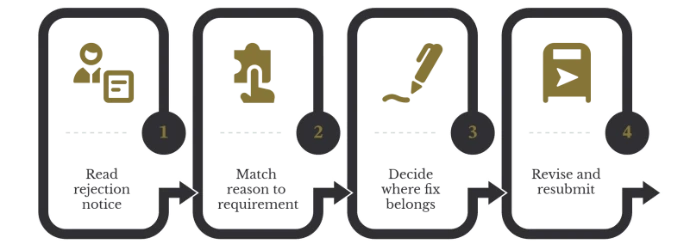
You fix a denied QDRO by finding exactly which requirement the plan says was not met, correcting the order (or the agreement behind it), and resubmitting. The steps usually look like this:
- Read the rejection notice and the plan's QDRO procedures. The notice should say what the plan found.
- Match each reason to a requirement. Was a required detail missing? Did the order ask for a benefit the plan doesn't offer? Did it conflict with an earlier order?
- Decide where the fix belongs. If the problem is in the order itself, the order is revised. If the settlement language is the issue, such as missing loan language, your attorney typically needs to amend the agreement.
- Revise and resubmit to the plan. Keep the review period in mind, since the amounts held separately are protected for a limited time.
A late or revised order is not necessarily a dead end. Under a federal regulation, an order isn't disqualified solely because it was issued after the divorce or because it revises an earlier order. It still has to meet the same substantive requirements, and no one can promise a plan will accept a particular order, but timing alone does not close the door.
A Settlement Language Checklist to Review Before You Sign
Prevention is easier than repair. Jay Mota's settlement language checklist covers the items to confirm are written into an agreement:
- QDRO language is in the agreement, so the order can be drafted to match it.
- 401(k) loans are addressed, whether or not a loan exists.
- Survivorship benefits on defined benefit pensions (employer-funded plans that pay a formula-based income for life) are addressed in writing.
- The order of operations is spelled out for any separate amount, because subtracting it before or after splitting changes how much is divided.
- Every benefit the plan offers is captured.
Two more habits help. Ask the plan for its QDRO procedures early. And consider plan review of a draft before the order is entered. QDROs are technical documents where mistakes are easy to make.
This checklist is general information, not legal advice. Your attorney is the right person to confirm what belongs in your agreement.
Why Work With a Certified QDRO Specialist?
Because every plan has its own rules, and one plan's order may be rejected by another, a specialist who drafts to the specific plan can help you avoid preventable denials. The court does not approve language the plan won't accept, so the plan-specific work has to happen before the order is final.
Jay Mota, CQS® and founder of Divorce Logic, recommends having your settlement language reviewed by a certified QDRO specialist before you sign. That is when gaps are easiest and least costly to address.
Our QDRO work includes:
- Review of settlement language before signing
- Plan-specific drafting for 401(k), 403(b), pensions (defined benefit, money purchase, cash balance), profit sharing, and ESOPs
- Pre-approval submission to the plan, court signature, and final submission to the plan administrator
- Coordination with the plan administrator and the attorney
- Review of existing QDROs as well as new drafting
We work alongside your attorney, who remains central to your case. That is how we bridge the gap between finance and law. To learn more about the service, see our QDRO drafting services page, or read what a QDRO drafting specialist does.
Frequently Asked Questions
Why do I need a QDRO if my settlement already says I get half the 401(k)?
As Jay Mota puts it: "A settlement agreement awards you a percentage of a retirement plan. But when it comes to retirement division, the plan administrator reads the QDRO, not the agreement." The agreement records what you decided, and the QDRO is the order the plan reads and carries out.
Can a denied QDRO be fixed and resubmitted?
Often, yes, though no one can promise a particular result. Under a federal regulation, an order isn't disqualified solely because of when it was issued or because it revises an earlier order, but it still has to meet the same requirements as any other QDRO.
Will the plan tell me why my QDRO was rejected?
It should. DOL guidance says plans must notify the parties of their decision and that a rejection notice should explain the reasons and what changes are needed. If the notice is unclear, ask the plan administrator and your attorney to help you interpret it.
When should a QDRO specialist review my settlement language?
Before you sign. Jay Mota recommends having the language reviewed by a certified QDRO specialist at that stage, because a gap found afterward can send you back to your attorney to amend the agreement.
Do I still need my attorney if I work with a QDRO specialist?
Yes. Your attorney advises you on your agreement and your legal rights. We work alongside your attorney and coordinate with the plan administrator on the retirement division.
Schedule a Confidential Consultation
Free, secure, and no obligation.

Jay Mota, MAFF, CVA, CDFA, CFP, CQS
Founder and Principal of Divorce Logic
Jay is a nationally recognized divorce financial professional and has worked in financial services since 1997. As a divorce financial forensic expert, Jay reviews and analyzes the financial circumstances of individuals who are considering, navigating, or finalizing a divorce. He provides insight, analysis, projections, and strategic guidance to clients and attorneys to support informed decision-making and potential settlement.
Jay serves clients in all 50 states, helping them navigate complex financial situations during divorce with confidence and clarity.